I went for a walk down to the beach to see the crabs. I am staying in a shack to the east of Hobart, and watch the light across the bay change each day, aware that this is a place of constant changing.
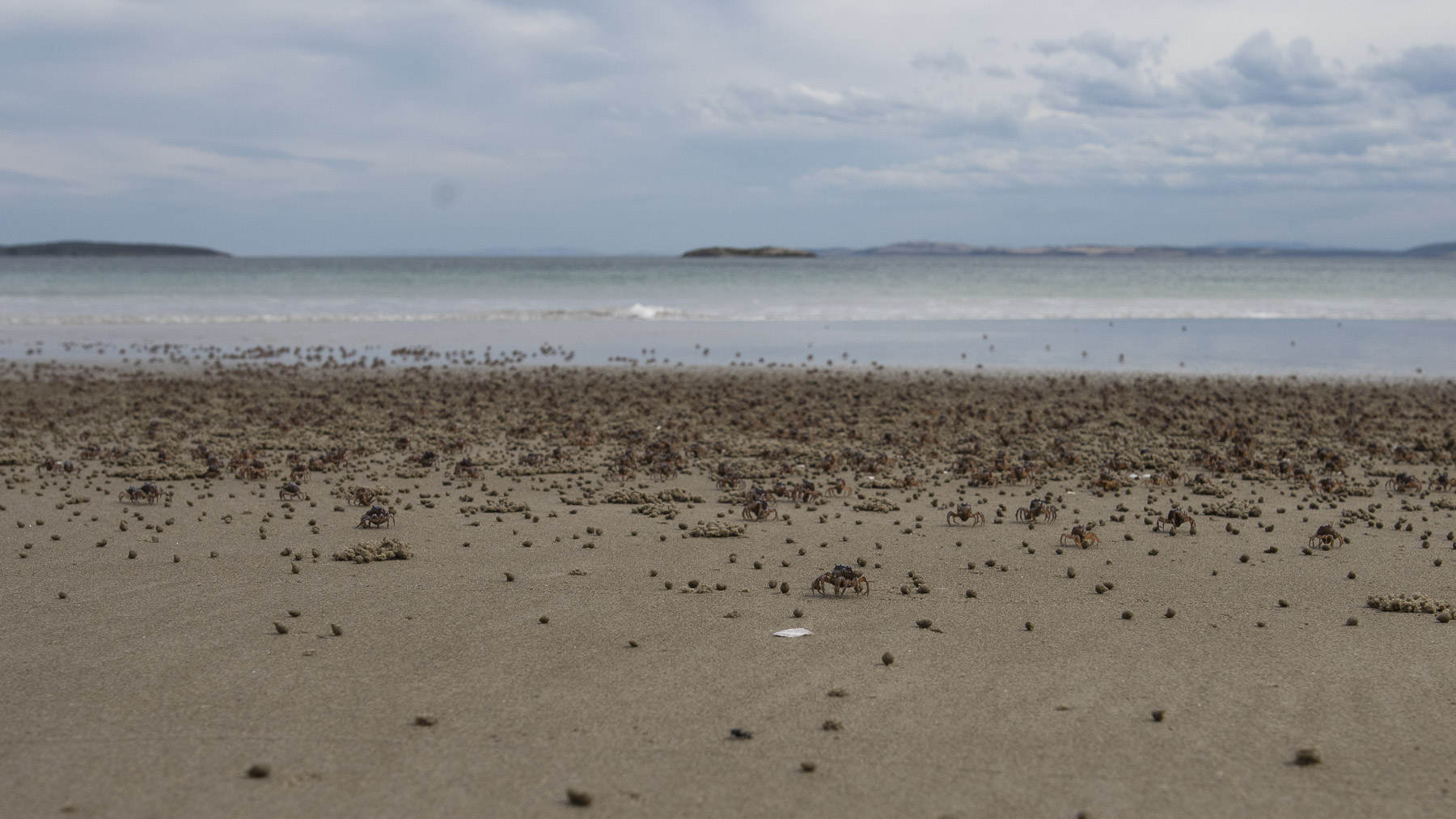
Looked up when they usually come out, and the internet informed me just at or before low tide, and I then looked up when low tide was, and the internet informed me in about 90 minutes from then, so after some lunch and a few emails I got myself ready. I wandered down the hill and over the dune to the foreshore, and saw further up the beach the mirage-flickered shadow of lots of tiny little things, hundreds of crabs. I walked further up the beach to see more of them, slowly approaching, watching a small cluster of them, before realising that the mass of them further up the beach had grown immensely in number, a swarming of crabs across the sand.
I walked further up the beach, watching the way the crabs clustered up in small waves according to where the tide had deposited the sand, sat in the very slight lee of the oncoming waves, a bracing wind ripping across from further up the beach, across the soft sand, and dragging twisting and dancing runnels of white, dry sand down across the beach into the ocean, tumbling little clusters of crabs as they did.
They’re so small, little cubes with legs, scuttering along at a slow pace, balling up little globules of sand by their mouths with their front legs and depositing them before moving onto another and then another. I found a mass of them, and lay down on my front facing them, letting them acclimatise, recover from the movement of me approaching, and they started wandering back up the beach. The funny terminator-like way they rise out of the wet-stained sand out past the line where the waves wash in, that still reflective sky-shining place where the water hasn’t quite drained from the sand, even as the wave has descended. A wave washes up, rogue, higher than the usual bunch, and sweeps up a hundred crabs along the shoreline, depositing them in a confused mess slightly further up the beach.
As I lay there, more and more crabs are buried, the little deposits of balled sand across the whole wet face of the beach, and the remaining crabs, emerging slightly later, are travelling all in a bunch trying to find places to rest. More crabs emerging, more crabs moving, spiralling motion, crab tornado across the face of the beach, and the sound of them: this hissing, scuttling, hush of a thousand, thousand little crab legs on hard sand and the distant whoosh of the sea.
It’s curious the way your ears can focus in on a particular sound and drown out the others, similar to how the eye finds focus and the foreground and background are blurred, a tightening of intention to a single plane of focus, a precise distance found by the instant, unknown flex of the muscles of the eye. I can’t imagine there’s a similar process for the ear, a physical blocking or changing of the membranes and bones that make up that strange shell of an apparatus, so it must be happening inside the brain itself. The cerebral narrowing, paying attention as is desired, a blocking out of the noise and signal.
There is a noise in the manner of the crabs moving too, a chaos that only to view very close up do you see each individual has a desire and plan; from the air, from the distance of the dunes it is just the writhing of a mass. Tiny little eyes on thick stalks, bulk of cuboid body, white and blue and red and the colour that is not a colour – that patriotic mix of a flag and the invisible thing a flag represents. Soldier crabs, why are they named that – for their uniforms? Their colour? Surely not, surely some manner of organisation or marching plans, the way they seek out a goal, perhaps how they dig a foxhole (crabhole, perhaps) and hunker down, or the way they emerge all at the same time, like on a signal or flare, and storm the beach from the coast, their own miniature daily Normandy.
As I was leaving, I walked further down the beach to a spot where there were less crabs to disturb and stood in the waves up to my ankles, letting the swell wash over my feet with its cold brevity, and encountered that gentle quicksand feeling, of standing in a slight depression that was solid a moment ago, the wave washing away the foundation from where you’re standing, and then realised that in each of the slight divots where I had previously stood, there was a small white shell, a tiny little scalene triangle of a thing, reminding me of the curve of a chromaticity diagram, that wide arc that shines through a hundred shades of white as light reflects off its microscopic facets and ridges.
But not just empty shells! Out of the corner of each, a tiny little tendril of muscle, searching and rooting the shell to the sand so as to not be washed away. As I walked across the beach, a few meters or so, a hundred tiny white shells appeared, dredged out of their hiding place in the sand by my steps and the waves that filled them, their hiding place ever so brief against the pushing and pulling and sucking and moving of nature. All of a sudden, like a crashing vision it was apparent to me: this beach, that I had taken as a stretch of sand crystals that had things live on them, and wash across them, but inert and dead, contained in fact a hundred thousand little lives, things that move and wriggle and dig and hunt and hide and swim and burrow and search and live day by day across the great living expanse of this crescent bay, a heaving, moving, alive thing that breathes with the tide and the moon and each day passing and as the bay shifts in temperature and salinity throughout the day and as the wind blows in from the north-west and as the rain threatens on the horizon, in the distant hills that shroud the city, and since before I was born and until after I am dead. This is a thing that lives, that pulses and flows with life.
Excerpt from diary written 17/2/26 in nipaluna/Hobart, Tasmania.